
It appears that your browser may be outdated and performance may be limited. The My Study builder is best viewed with the latest internet browsers. However, if you’d prefer to use our standard form, you can access it below.

Go to Internet Explorer Quick Quote Form

Dismiss this message

The Science of Sleep

Uncovering the Science of Sleep

Quality sleep is a cornerstone of overall health, yet many struggle to get the rest they need.

Sleep is one of the foundational pillars of health, yet it is often the most neglected. Despite its well-established role in physical and mental well-being, sleep deprivation is becoming a growing public health issue. According to the CDC, about 35% of adults in the U.S. report getting less than the recommended 7 hours of sleep per night. Additionally, the National Sleep Foundation reports that up to 50% of the population experiences occasional insomnia, highlighting the widespread impact of sleep deprivation on overall well-being. Over time, diminished sleep quality contributes to a wide-range of health and quality of life issues, such as:
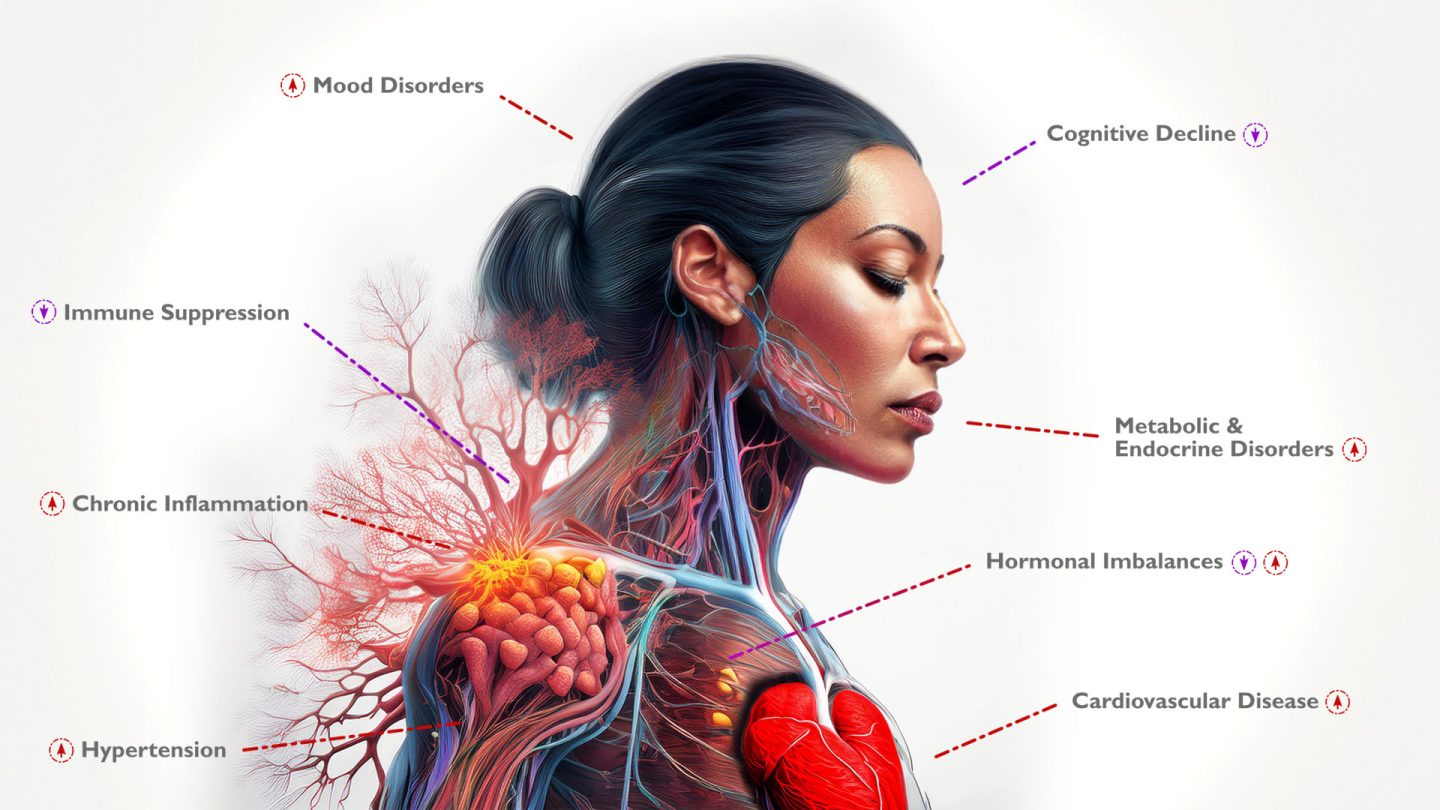
U.S. Adults with Chronic Sleep Disruption

90.3 Million

Source:
Centers for Disease Control and Prevention (CDC)

impact-of-chronic-sleep-disruption-illustration

Melatonin, a hormone naturally produced by the pineal gland, plays a crucial role in regulating the sleep-wake cycle. As evening approaches, melatonin levels rise, signaling the body to prepare for sleep. This process not only helps in falling asleep but also ensures that sleep is deep and restorative. When melatonin levels are disrupted, whether by stress, light exposure, or irregular sleep schedules, it can lead to poor sleep quality and, consequently, negatively impact overall health. By understanding and optimizing melatonin production, individuals can improve their sleep and, in turn, support their overall physical and mental health.

SEMINAL PUBLICATIONS

  1. Dollish, H.K., Tsyglakovam, M., McClung, C.A. (2024). Circadian rhythms and mood disorders: Time to see the light. Neuron, 112(1):25-40.
  2. Brown, T. M., Brainard, G. C., Cajochen, C., Czeisler, C. A., Hanifin, J. P., Lockley, S. W., Lucas, R. J., Münch, M., O’Hagan, J. B., Peirson, S. N., Price, L., Roenneberg, T., Schlangen, L., Skene, D. J., Spitschan, M., Vetter, C., Zee, P. C., & Wright, K. P., Jr (2022). Recommendations for daytime, evening, and nighttime indoor light exposure to best support physiology, sleep, and wakefulness in healthy adults. PLoS biology, 20(3), e3001571.
  3. Fishbein, A. B., Knutson, K. L., & Zee, P. C. (2021). Circadian disruption and human health. The Journal of clinical investigation, 131(19), e148286
  4. Cipolla-Neto, J., Gaspar do Amaral, F., (2018). Melatonin as a Hormone: New Physiological and Clinical Insights. Endocrine Reviews, 39(6), 990–1028. PMID: 30215696
  5. Murray, J.M., Sletten, T.L., Magee, M., Gordon, C., Lovato, N., Bartlett, D.J., Kennaway, D.J., Lack, L.C., Grunstein, R.R., Lockley, S.W., et al. (2017). Prevalence of Circadian Misalignment and Its Association With Depressive Symptoms in Delayed Sleep Phase Disorder. Sleep 40(1), 10.1093/sleep/zsw002.

*Note: This information is provided for research use only. Information is not provided to promote off-label use of medical devices and is not intended to diagnose, treat, cure, or prevent any disease, condition, or be used for medical purposes of any kind. If you have questions regarding this information, please connect with your healthcare provider as Salimetrics cannot provide medical advice.

Contact: Salimetrics (USA)
View All International Distributors